“The more you can control anything in your business as an artist and have ownership of it, the more you’re winning.” – Jeff Nedza
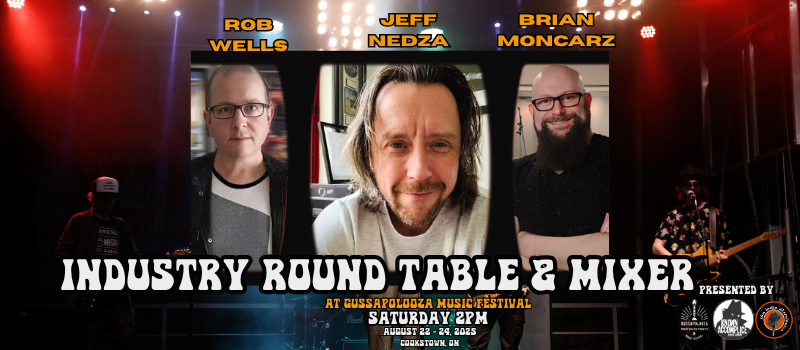
It was in a rustic barn during the 2025 Gussapolooza Music Festival that three industry veterans took the stage for a panel discussion about “Cutting Through: Industry Round Table & Mixer”.
From building an indie band’s marketing list to production trends and performance strategy, the panelists brought decades of combined knowledge and shared it with an attentive crowd.
Panelists
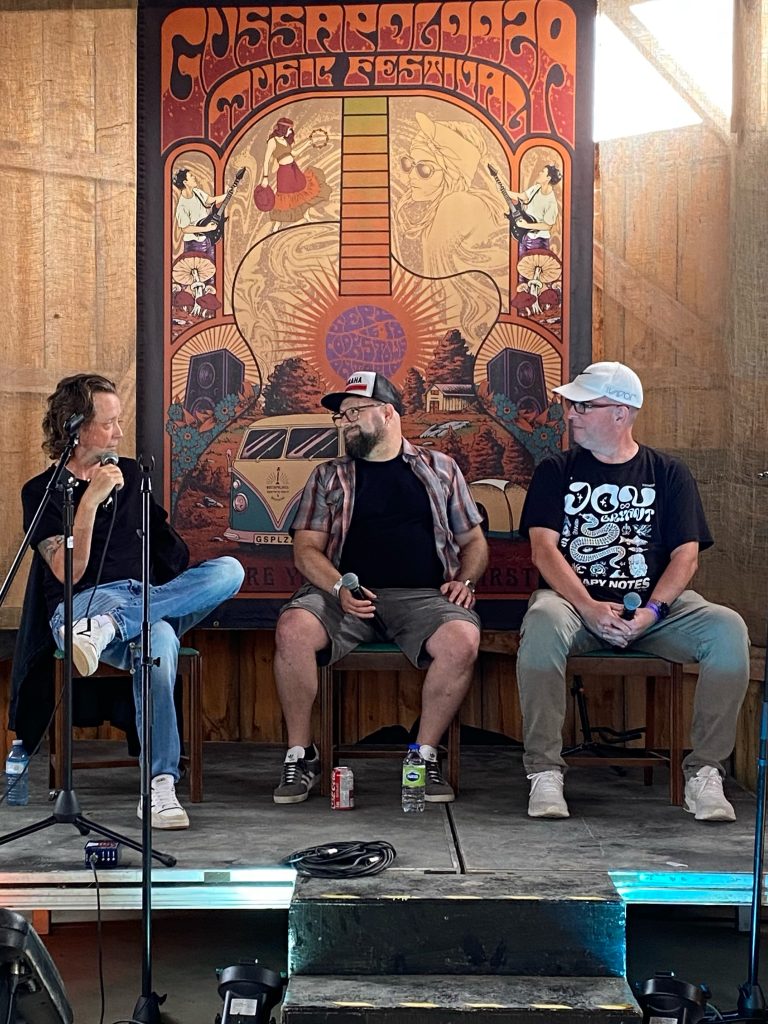
Brian Moncarz, one of Canada’s leading rock producers and mixers, with credits including Alice Cooper, Our Lady Peace, The Tea Party, and The Trews. His projects have racked up over 150 million streams, dominated rock radio, and landed licensing deals with the NHL and ESPN. Brian continues to push boundaries while co-writing and producing for the next wave of Canadian talent.
Rob Wells, a multi-platinum, JUNO- and ECMA-nominated producer and songwriter whose credits stretch from Ariana Grande and Justin Bieber to Weezer, Cyndi Lauper, and Serena Ryder. His work has sold tens of millions of records, and been heard on everything from Sesame Street to FIFA. Rob is also an educator at Harris Institute and host of the Women in the Music Industry podcast.
Jeff Nedza, the panel moderator, is the founder of Known Accomplice, managing the label roster that includes artists like Sam Roberts, The Trews, Texas King, Bleeker and One Bad Son. Jeff also manages Bleeker, who performed at Gussapolooza as a headliner. With 20+ years in marketing and brand building in the arts and entertainment industry, Jeff has helped shape careers through strategy, storytelling, and content creation.
On that sunny afternoon at Canada’s premier indie festival, the discussion was candid, accessible, and packed with practical advice. Indie bands in the audience later remarked they’d learned “a month’s worth of insights” in just over an hour.
What follows is a cleaned-up transcript of the panel discussion.
DIY vs. Collaboration
Jeff Nedza: So, how do artists balance self-production in today’s DIY world versus collaborating with seasoned professionals? Is there still growth without mentorship and feedback?
Brian Moncarz: That’s a super-challenging question. Is there growth? Definitely. There are so many tools at artists’ disposal right now. The number of songwriting demos I hear that sound close to being a master is pretty crazy. Sometimes I wonder, what am I going to do to make this better? Obviously, artists come to me for that, but I do think they can grow on their own. There’s so much information available. I find artists today often have a better understanding of themselves than when I first started out. With the ease of targeting an audience now, they understand who they are and what they’re trying to do. As a producer-songwriter, I can help get them to the finish line.
Jeff Nedza: Rob, to expand on that: at what point should an artist outsource production or co-writing to elevate their sound?
Rob Wells: I honestly think everybody should learn how to produce, at least to a certain point. It might not feel fun at first — you’re staring at a computer for hours — but it’s important to understand the basics. Then when you work with a producer, you can speak in an educated way about what you want.
I started as a songwriter. I wasn’t happy with productions coming back, so I thought, can I produce? At first I thought no. But anybody can learn. It’s like climbing a mountain: one step at a time. Before you know it, you understand production.
I can’t imagine being an artist and not knowing how to produce. That would be frustrating — having an idea and then waiting weeks for studio time. Start simple: use apps on your phone, record yourself, put tracks together. Move to GarageBand, then to a more advanced DAW. I use Cubase, but they all do the same thing.
“If you’re just following TikTok trends and your heart’s not in it, imagine if something took off and you had to perform that for the rest of your life. There would be no worse hell than that.” – Rob Wells
Collaboration is also key. Imagine wanting to be the best tennis player in the world but only ever hitting a ball against a wall — you can only get so far. When you finally play against someone, you learn and expand. Same with co-writing: I thought I was a great songwriter until I started co-writing and realized I was a terrible lyricist. Collaborating taught me so much.
Songwriting vs. Social Media Trends
Jeff Nedza: One thing we’ve all talked about — sometimes frustrated, sometimes thrilled — is songwriting and how important the actual song is. Are young artists writing for emotional depth, or for TikTok virality? Can they do both?
Brian Moncarz: For the artists I work with, the common thread is musicianship and great vocals. That’s what sets bands apart. We focus on artistry more than what’s going to work on TikTok. We might record a song that won’t be released for six or seven months; what trends today likely won’t be relevant then. For me, the priority is connection — making sure the song connects.
When I worked with Texas King, they sent demos. Two songs felt like bigger singles, but there was one odd demo, Whatever You Break. It sounded different. We recorded it quickly — pre-production in the morning, beds in the afternoon, vocals that night, overdubs and mix the next day. We didn’t overthink it. That’s the one the radio team pushed, and it connected. Spontaneity matters.
Jeff Nedza: And labels don’t always get it right. Take Bleeker. They submitted Let’s Go for seven years. No label interest. When it finally came out, it landed in NHL games, stadium hype reels, EA Sports’ NHL 25. It proves labels can be wrong.
Rob Wells: That’s why I warn against chasing trends. If you’re just following TikTok trends and your heart’s not in it, imagine if something took off and you had to perform that for the rest of your life. There would be no worse hell than that. Make music that speaks to you. By the time your song comes out, the fad will likely be over anyway.
TikTok is still valuable. Think of it like fishing: don’t pick the smallest pond; go where the fish are. The algorithm is smart. If you’re authentic and share your music consistently, it will find the right fans. You don’t have to chase trends.
Jeff Nedza: Still a valuable platform, for sure. Show of hands — artists who want to work TikTok as a platform? I think it’s valuable. Many authentic artists don’t want to buy into temporary trends, but a lot of acts are getting signed this way. It’s a good medium if used well.
I also think it’s powerful for finding fans. The algorithm is so dialed in that if you’re being yourself, sharing your music, and being present, it will find people your songs resonate with. You don’t have to do trends; fish where the fish are. Social media is here today, gone later today, but that’s where people are — for now.
Rob Wells: Just always follow your art and your heart. There are 8 billion people on the planet; assume most won’t like what you do. Even if only 0.001% of people like what you do, that’s still 8 million people. Focus on your craft, release music that matters to you, and eventually you’ll find your tribe, so that at the end of your life you can say, “That was amazing. I followed my heart,” instead of, “I chased a trend and it didn’t work — or it did work and I spent my life doing something I don’t believe in.”
Finding Your Sound & Sonic Identity
Jeff Nedza: That brings up a great point that leads to my next question: in an environment that emphasizes metrics and trends, how do emerging artists develop a signature sound in a world of trend-chasing and genre-bending? How do they stay themselves?
Brian Moncarz: You’re asking tricky questions! I’m always searching for bands doing something a little different — not just following trends. I’m a fan of live music; I want to be captivated by a band on stage. That still holds true. When we saw Texas King together, we were both amazed at how great they were live. They knew who they were; they just needed a little help at the finish line. There was a disconnect between their live show and the records. In the studio, the best thing was to record live, to capture that energy on record.
Jeff Nedza: That’s interesting. I always ask artists: what’s your secret sauce? What’s your unique value proposition? For many, it’s the live performance. Ideally, the songs connect, but the live show wins people over. Social media is a means to an end — a way to get people to recognize you, then come to a show and truly “get it.”
From the label side, we’ll work songs. An artist might get a #1 on radio, and then their catalogue streams start to creep up because listeners go find the familiar hit. The entire picture matters. It’s often the live moment — what I jokingly call the “bro moment”: you’re at a show with friends, have a great time, and that solidifies it as part of your life’s soundtrack. For Texas King, their unique value prop was being a furious live band. Then you bring that into the recorded music to bridge the gap.
Brian Moncarz: Exactly. I was lucky to be part of a session with Alice Cooper and Bob Ezrin. I was engineering; Alice was behind me singing into an SM7B. Bob Ezrin was beside me with lyric sheets. Alice would sing a line and Bob would say, “That’s great. Now make it sound more like Alice.” He’d lean into the signature rasp and do it again. Even Alice, 50 years in, benefitted from the reminder to bring what’s uniquely his.
Jeff Nedza: Next question for both of you: with emerging artists, how much are you thinking about sonic identity and brand? Are you focused on finishing a great song, or constantly developing that sonic brand?
Rob Wells: First, on finding a sound in a world of trends: when I was growing up, you had access to a limited number of new releases. Now, one of the first things I ask artists is: what are your three favourite songs right now? Your three favourite artists you wish you could sound like? Three productions you love and wish you could merge? The answers are wildly different — often bands I’ve never heard of. I love that everyone has access to a world of music that impacts them. It means projects don’t all sound the same because the ingredients are different.
As for brand: a producer’s job is to nudge people outside their comfort zone. Artists might come in with a fixed idea; I’ll introduce new things: “Have you heard this?” Based on their references, I’ll toss in a fourth that’s adjacent and might open a new channel of creativity. I’m never rigid at the start — I’m open to seeing where the music wants to go.
Brian Moncarz: I put a lot of emphasis on sonic brand during pre-production. Like Rob said, we’ll listen together to music we love and discuss why. Then we use those as a guide — while staying open and flexible. If a band loves Soundgarden, there already is a Soundgarden. What is it we love about those records sonically? Use that as a root and grow something new.
I usually come into a project with a sonic goal. Because I’m often producer, engineer, mixer, and sometimes co-writer, it helps me stay grounded and not lose the plot at mix time. We push boundaries, but we stay open-minded. If something sounds too much like a reference, we’ll push it away.
Jeff Nedza: Are there times when you need to dial it back — “that’s way too much Zeppelin,” etc.?
“Repertoire is always the key factor. Shows are great, looks are great, but it doesn’t mean much if the song isn’t there.” – Jeff Nedza
Brian Moncarz: It happens. Sometimes we stumble onto something that’s really close — a tone, a riff. It’s hard to be unique, especially in rock, but if it sounds too much like something else, that’s a problem. We’ll push it away.
The Long Game: Career Building & Expectations
Jeff Nedza: Maybe a tougher one for two producers/songwriters: what challenges are you seeing around building fans — streams, monthly listeners — in a short window? I often ask artists, what does success look like in one, three, five years? Many assume things happen faster than they do. I’m planning releases now for late next year, but expectations are often immediate. Are you seeing that?
Rob Wells: For sure. The expectation of things happening fast — I don’t wish that on anyone. You release a first single, it takes off, and then the second single underperforms. My discography might look like nonstop hits, but that’s not the case. I wanted this career at 18; it took 13 years before anything happened — just a small success in Canada. It was frustrating, but looking back, it was best. I wasn’t prepared to climb big mountains yet. I needed years of small hills — learning to ascend and descend — before bigger ones. Eventually, Everest came along. I ascended, looked around, and 15 minutes later someone said, “Get off — someone else wants to be up here.” Back to base camp.
I wish a slow build for artists: first record, get 200–500 fans; next, 1,000; next, 10,000; then 200,000; then the big worldwide hit. It’s a great way to get used to the schedule of running a company rather than going from zero to 100 and crashing. Build fans steadily and you’ll have a lifelong career.
Jeff Nedza: Do you agree with the “one fan at a time” approach?
Rob Wells: Oh yeah. Every release is a chance to gain one fan — someone who says, “I like what you’re doing.” Be patient and work hard. I did it for free for 13 years because I loved it. I had a day job to pay the bills, but every evening and weekend I worked on my craft. Knock on 100 doors; if one opens, great. Slow, steady climb.
Brian Moncarz: I agree. I’ve been doing this for 25 years now.
Jeff Nedza: We’re aging ourselves with these comments!
Brian Moncarz: It’s hard to put myself in artists’ shoes sometimes. It’s always been challenging to cut through — that hasn’t changed. It’s frustrating. I deal with imposter syndrome like many artists do. Sometimes I finish a gig with nothing lined up and think, “That was the last time I’ll work in music.” I know it’s not true, so I hustle. That keeps me relevant. When a gig ends, I’m on the phone with management, labels, taking meetings, finding the next project. Artists need to do the same: when a gig ends, start planning the next one. If you want success, you have to push and work. There’s no overnight success in rock. Get on stage, play hard, win fans. Still relevant.
Jeff Nedza: Back to what I said earlier about artists who understand who they are and where they are in their trajectory. I’ll ask new artists, what does success look like in a year? Someone at 2,000 monthly listeners says, “500,000.” That’s a massive leap. How many songs are you releasing? Are you touring? How will you get there? Reasonable expectations draw me in. Those artists tend to have longer careers. If you set the high-water mark unrealistically, you’ll likely be disappointed — which is demotivating. But if an new artist says, “We’re aiming for an increase of 20,000 monthly listeners and 25,000 new streams; and here’s how we’ll build to that” that’s thinking smart, with a plan. People like me pay attention when the plan is thought out and reasonable out of the gate before a label or team is involved.
Producer–Artist Dynamics
Audience Member: I’m a producer. If a client keeps pushing for more — like vocal samples, “I have to hit this, I have to hit that” — how do you encourage them that what they already have is good? I hear it and know it’s right, but they don’t. Anything you’ve done to cool them down or make them feel better?
Jeff Nedza: It’s an artist-expectation question: how do you manage expectations when the artist hears it another way?
Brian Moncarz: That’s tough, and common. I’ll go back to the sonic goals we discussed earlier. I’ll bring the artist out of the booth — not over talkback — sit down, play back what we recorded, and talk about our expectations and why. I like a raw vocal with emotion — that’s what I connect with. We’ll use tools to tune a bit, but I’d rather hear a slightly out-of-tune, very emotional vocal. Sometimes artists are afraid to be vulnerable, and they push away from connection. The best vocals often have vulnerability — a crack in the voice — and I’ll push to show them why it works. Then I’ll say, let’s live with it. If you’re unhappy tomorrow with fresh ears, we’ll try again. I’m hired because people trust my opinion, so there’s a level of trust.
Jeff Nedza: From the label side: seek to understand, not to be understood. I’ll ask, why do you hear it that way? Why do you want it that way? Let them voice it. Often, talking it through highlights where the logic doesn’t apply. As a producer though, there’s also the service aspect: when someone’s paying you, the artist often wants what the artist wants.
Rob Wells: I’ve worked with so many vocalists. Most get what we need within five to ten takes. Some need twenty to find their vibe — experimenting until we suddenly capture that magical moment.
Jeff Nedza: We’ve all got memory banks full of scenarios like that. You give all the reasons to do it one way, try to guide and influence, and ultimately the artist wants what they want — and you let it go.
Audience Member: I’ve been doing it ten years, smashed my head against a million walls. I try to give them exactly what they want, but sometimes it’s already perfection. Where do we go after perfection? I don’t use Auto-Tune; I naturally bring voices together. I ran into this one time…
Jeff Nedza: If it were only one time, that’d be weird. I’ve run into it a lot. Sometimes those projects just go how they go. I never advocate being the “I told you so” guy, but sometimes…
Artists should be wary of “demo-litis.” You get used to hearing something one way and can’t unhear it. That applies to executives and A&R too, from the label side, I’ve had definitely had artists give me demos I can’t unhear. Then they record with a producer, and it changes as it often does. On the last Trews album, Enemy — the first version they sent me gave me goosebumps. The final changed a bit. Still a really great song, but I still hear the demo, I also love the final mix so no big deal.
What Industry Pros Look For
Audience Member: My name is Paul. I’m the front man of Many Minds. I’m here spreading the word; playing with Shoemaker Levee September 12. I’m consistent and have a vision. My question: if you could pin one thing that intrigues you and gets you into someone’s music, what would it be? Is it the music, or the whole package? What makes you listen?
Rob Wells: For me, it all starts with the song. I always listen to the song before I know anything about the artist. If song one blows me away, I go to song two. If it’s just okay, I’ll try song three. If I’m consistently blown away, great — it’s always about the music first.
Beyond that, I’ll talk with the artist. If it feels good, can we hang for a day? Have lunch, swap references. It’s music first, the hang second. Do I believe in you 100%? Do I think you’re awesome and I’m lucky to work with you? If the hang isn’t great but the music is, it probably won’t happen. If the hang is amazing but the music isn’t there, also unlikely. I’m looking for three legs of a tripod: talent, personality, and drive. All three have to be strong.
Jeff Nedza: Great question. Two adds: first, what you’re doing — persistence — is fantastic. Don’t let rejections set you back. Everyone’s trying to do what you’re doing; take “no’s” off the table. Build socials, strengthen songs, network with peers — it’s not a zero-sum game.
Second, personality is key. When I meet an artist with drive and a great energy, I’m rooting for them. If they’re actively working and motivated, it’s hard to say no or not pay attention. Keep that attitude.
Brian Moncarz: For me, it often comes down to a voice. If someone sends music and I love the voice — not necessarily the “best” voice, but one with character I connect to — that starts the conversation. Songs are crucial to the outside world, but if the voice is great and the songwriting is just okay, co-writes can still get us to great songs. Then I’m looking for someone great to collaborate with. The successful projects over 25 years were the ones with great collaboration and open minds. And yes — rejection happens constantly. Brush it off and use it as fuel to be the best version of yourself.
“By the time I hit 50, I didn’t think I’d still be hustling like I did at 20 — but that’s what keeps me relevant.” – Brian Moncarz
Jeff Nedza: Any other questions?
Audience Member: Would you suggest working with different producers if I’m in Country Music?
Brian Moncarz: These days, especially in pop, artists work with different producers/writers with different strengths. I often get calls as a “rock guy” for a pop-leaning artist who needs one song with more edge. One producer can help stitch together a cohesive sonic identity across a project — that’s valuable — but we’re in a playlist generation. Finding the best person for each song can also help.
Jeff Nedza: It also comes down to how much you want to advocate for your identity. If you don’t choose the right people, they might force their ideas or direction on you, and your project can end up with an identity crisis — that’s a “no” from the industry. The flip side: working with many people early helps you figure out who you are. It’s a balance. Follow your gut, but don’t default to your comfort zone — that keeps you in a small box. Good collaborators will push you within your brand.
Rob Wells: If you are working with different producers, have someone overseeing the whole process so it feels cohesive — like a showrunner on a TV series. Different directors, same show. Slight differences are fine, but it should feel like one cohesive piece of art, especially for emerging artists who need to “fit in the box” a bit so the industry knows how to position you.
Building Your Core Fanbase
Audience member: When you’re talking to artists about establishing their core group, do you recommend cultivating an “earned list” — an email list — instead of only social media?
Jeff Nedza: 1,000%. From a marketing/label perspective, if an artist manages and actively builds their own fan list, that instantly tells me they have an audience ready for the next thing. There are great tools for this. Laylo is one of the best for developing artists — you can use the free tier. It integrates with Spotify. Any time you do a pre-save, sell merch, or drop something, you can message fans: “Want early access? Sign up.” You own that list. The people who give you email/phone are your core — more engaged than passive social followers.
I work with established acts who can predict day-one streams because their Laylo text/email goes out at 9 a.m. Day-one, week-one, month-one numbers matter. Watch Discover Weekly and radio signals. Those are KPIs for how the platform will push your song.
Audience member: The environment is shifting fast — platforms get acquired or change. There’s no predictability. But the juxtaposition is that industry people don’t see the numbers on your own mailing list unless it’s through a tool like Laylo.
“Think of a tripod: talent, personality, and drive. You need all three legs for the camera to stand.” – Rob Wells
Jeff Nedza: Right — we don’t see it unless the artist shares it with us. But on Laylo, for example, an artist we work with has a massive database. We can basically predict day-one streams because the text/email goes out and fans click right away. That early data feeds the algorithm. When you pitch in Spotify for Artists, you can even say you’re running a Laylo campaign and X amount of pre-saves — that means something.
Rob Wells: One artist I met in Ireland had a genius way to get email addresses: he bakes cookies and brings them to every show. “If you want a cookie, give me your email.” He walks away with hundreds of emails — fans of all the bands on the bill. Everyone wants a cookie.
Jeff Nedza: You’re only limited by your creativity. Use QR codes to sign up, enter to win merch, etc. Laylo lets you continually incentivize sign-ups at no cost: preview a video the day before release, DM fans to say thanks, offer fan-only experiences. That creates superfans, and superfans build careers. Meet people at the merch booth — even sizable artists do this. That personal connection lasts.
Audience Member: What are the top tips to make Laylo work for your band?
Jeff Nedza: Use it frequently — but don’t spam. Any time you release a track, tell people you have a “drop” coming and incentivize it. Get creative with messaging. Don’t “sell”; invite people behind the scenes — tour van, backstage, studio moments. Offer early access to tickets, fan-only hangs, experiential stuff. You know your audience best; focus on engagement and bringing people into your world.
We came up in an era with a wall between artist and fan. Now people can DM you. Encourage questions and conversation. Personalize the experience and offer things they can’t get from a regular Reel or TikTok. That’s how you create long-lasting relationships.
Audience Member: Are you engaging inside the Laylo app or on social?
Jeff Nedza: When you create a drop, you generate a link. Post that link wherever you post links — Instagram, TikTok, X, wherever. Fans sign up there; the app stores contacts. On the backend you see sign-ups, emails, phone numbers. When you send an update, there’s no wait time — just be mindful of send limits by tier. Be intentional: shows, tickets, merch, meaningful updates. You can also keep a passive “join our list” link live at all times.